Choosing the right Wrapping Paper For Food involves more than color, print, or price. The paper must suit the food’s moisture, grease, temperature, and time in transit. A crisp pastry can soften inside an unsuitable wrap. A greasy sandwich can stain a paper that looks sturdy on the roll. Small choices matter.
The Food and Agriculture Organization’s The State of Food and Agriculture 2023 estimates that 13.2% of food was lost after harvest and before retail in 2021. Packaging alone cannot prevent food loss, but appropriate protection can help preserve food quality during handling and distribution. Smithers’ The Future of Food Packaging to 2028 also examines changing packaging needs and material performance, useful context for comparing paper options. Reports provide a starting point, not a substitute for checking a product’s intended food-contact use.
Packaging scholar Dr. Susan Selke’s work offers a practical lens: assess packaging in relation to the product it protects. A concise takeaway for this guide—not a verbatim quote—is, “Choose paper for the food’s real conditions, not just its shelf appeal.” Look closely at grease resistance, moisture barriers, heat tolerance, sealing, and disposal guidance. Then test the paper with the actual food. A counter sample can reveal what a supplier’s description cannot. This guide’s seven tips will help you compare options carefully, ask better questions, and avoid choosing a wrap based on appearance alone. Some trade-offs remain. That deserves thought.
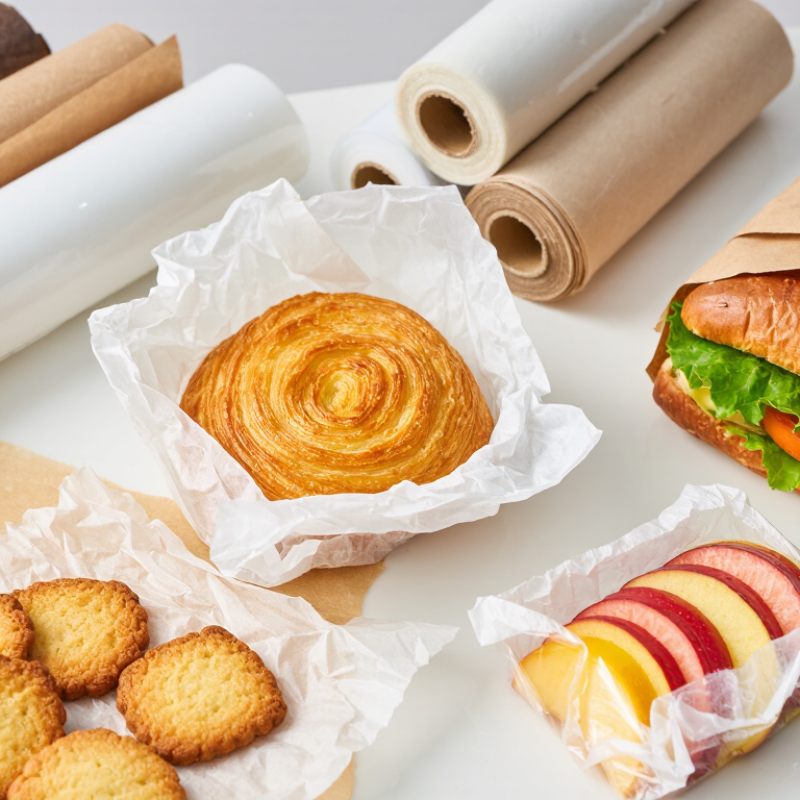
Food-safe wrapping paper is defined by its intended use, not its appearance. A brown kraft sheet may look clean, yet it is not automatically suitable for direct food contact. Check the package for that specific use, plus any limits for hot, cold, oily, or moist foods. Not every paper qualifies.
Uncoated food-grade paper can suit dry foods, while greaseproof paper helps contain buttery pastries. Wax paper works for many cold foods, but it should not be used as oven paper. Parchment is often made for baking; check its temperature rating and coating details. The label matters.
Avoid decorative gift wrap, printed craft paper, and newspaper unless the manufacturer says they are suitable for food contact. Their inks, finishes, or adhesives may not be intended for food. It is easy to assume that clean-looking paper is safe; that assumption is too loose.
For a warm, oily sandwich, choose paper rated for those conditions. Then check whether grease seeps through during normal use. Even careful choices can be imperfect, so match the paper to the food rather than relying on appearance alone.
Choose paper by the food’s moisture, temperature, and texture, not by appearance alone. For dry cookies, bread, or crackers, plain food-grade paper can keep items tidy without trapping much moisture. Greasy pastries need parchment or another grease-resistant paper, so butter stains do not spread through the wrapping. For chilled cheese or a cold sandwich, food-grade waxed paper can be useful. Keep it away from ovens and hot pans; wax coatings are not made for every heat level.
Hot food needs a different choice. Parchment can handle oven heat when its packaging says it is oven-safe, while food-grade butcher paper may suit some cooked meats or sandwiches. These papers are not interchangeable, though. A juicy filling can leak through ordinary paper, and a tight wrap around steaming bread may turn the crust soft. I used to assume thicker paper solved that problem. It didn’t, at least not reliably. For wet or saucy foods, use paper specifically labeled for that contact, or choose a leak-resistant container. Check the package directions, especially when food is hot, oily, or acidic. Some details matter more than the paper’s color.
Grease, moisture, and heat can turn a tidy wrap into a soggy mess. Start with the food itself: oily pastries need stronger grease resistance than dry bread, while warm, steamy fillings challenge both the paper and its seams. Ask suppliers for test results, not just claims such as “greaseproof.” TAPPI T 559 uses a kit scale from 1 to 12; higher ratings indicate greater resistance to grease. TAPPI T 441 measures water absorption with the Cobb test, reported in grams per square metre. Lower absorption generally suits wetter foods, though the right limit depends on contact time and use.
Heat needs a separate check. The FDA Food Code (2022) sets 135°F (57°C) as the minimum hot-holding temperature for food. That is a food-safety benchmark, not a paper heat rating. Confirm the wrap’s stated temperature range and whether it is intended for hot contact, reheating, or neither. A paper that handles a warm sandwich may soften around a steaming filling. Small details matter. Check the folded corners too; leaks often start there. Test a wrapped sample with the actual food, left in place for the expected serving time. Results can vary with coating, food temperature, and storage, so one quick kitchen trial is useful—but it is not a substitute for documented test data.
Tip 1: Measure the food, then add room for folds and overlap. A sheet that barely covers a sandwich can spring open at the corners; an oversized sheet may bunch around a pastry. For stacked items, check the finished parcel, not just the food’s flat dimensions. Fit matters.
Tip 2: Match the wrapper to the food. Oily pastries need suitable grease resistance, while chilled, damp foods need paper that holds together when moist. For warm items, check the supplier’s temperature and food-contact specifications; ordinary wrapping paper is not automatically suitable. Test one wrapped portion before ordering a large roll. A simple check.
The Flexible Packaging Association’s 2023 State of the U.S. Flexible Packaging Industry report estimated 2022 sales at $42.9 billion, about 21% of U.S. packaging sales. That figure covers a broad packaging sector, not food-wrap performance, but it shows the scale of material choices. Tip 3: Trial the actual wrap on your menu items. Check whether folds stay closed, grease marks show through, or paper tears during service. One easy mistake is judging a sample while it is dry and empty. Food changes the result.
Reusable food wraps can reduce single-use waste, but only when they suit the food and get used repeatedly. Check that the material is labeled for food contact, then follow its care instructions. A washable cloth wrap may work for a sandwich or a firm piece of cheese. It may be less practical for oily leftovers or anything that needs an airtight seal. Not every reusable option fits every lunchbox. That is easy to overlook.
After use, clean and dry wraps fully before storing them. A damp wrap tucked into a drawer can develop odors or mildew. Keep clean wraps in a dry cupboard, away from raw-food drips and strong-smelling items. Inspect seams and coatings for cracks, peeling, or lingering residue; replace a damaged wrap rather than trusting it with food. For safety, avoid reusing material that touched raw meat unless its instructions specifically explain safe cleaning. Small details matter.
Environmental impact depends on the whole routine, not just the label. Washing a wrap takes water and energy, while a durable one may replace many disposable sheets over time. I sometimes reach for a disposable option out of convenience, even when a clean reusable wrap is nearby. That habit is worth noticing. Compare expected lifespan, cleaning needs, and local disposal options before choosing. A material described as compostable may need a specific facility, so check what is actually available nearby.
| Tip | Wrap Type or Feature | Best Use and Practical Check | Reusability and Storage | Environmental Consideration |
|---|---|---|---|---|
| 1. Match the material to the food | Food-grade paper, parchment, foil, or reusable wraps | Choose a material labeled or intended for food contact. Use moisture-resistant wraps for damp foods and breathable paper for foods that should not be tightly sealed. | Follow the product’s cleaning and storage directions; keep clean wraps away from raw-food juices. | A suitable wrap can help prevent leaks and food waste. Consider the full use cycle, not just the material name. |
| 2. Check whether it can be reused | Reusable silicone covers or coated fabric wraps | Reusable options can cover bowls or wrap many ready-to-eat foods. Confirm that the product is designed for food contact and check its temperature limits. | Wash and dry completely between uses. Store flat or loosely folded in a clean, dry place. Do not use a wrap with damaged or peeling coating. | Repeated use can reduce single-use wrap consumption, but the benefit depends on how long the item lasts and how it is cleaned. |
| 3. Consider food safety when wrapping | Wraps used with raw meat, fish, or ready-to-eat food | Use a clean, leak-resistant option for raw meat and fish, and keep them separate from ready-to-eat foods. Avoid porous reusable wraps for raw animal products unless their instructions specifically allow that use. | Discard contaminated single-use paper. Clean reusable items according to their instructions and prevent raw-food contact from spreading to other foods. | Preventing cross-contamination and food spoilage is more important than reusing a wrap that cannot be safely cleaned. |
| 4. Plan for refrigerator and freezer storage | Moisture-resistant wrap or freezer-suitable paper | For freezing, choose packaging labeled for freezer use and seal it closely to limit air exposure. Label packages with the food and date. | Store wrapped food in a stable, cold area of the refrigerator or freezer. Reuse a wrap only if it remains clean, intact, and suitable for that purpose. | Good wrapping can help protect food quality and reduce freezer burn; avoid using more material than needed for a secure seal. |
| 5. Check heat and appliance limits | Parchment, waxed paper, and aluminum foil | Parchment is commonly used for baking within the package’s stated temperature limit. Waxed paper is generally not intended for oven use. Aluminum foil should not be used in a microwave. | Reuse parchment only when it is clean and not brittle, scorched, or greasy. Keep paper products dry and away from heat. | Recycling and composting options vary by material, local facilities, and food contamination. Check local rules before disposal. |
| 6. Choose a manageable size | Rolls, sheets, or reusable covers in several sizes | Select a size that covers the food with enough overlap to close securely. Pre-cut sheets or fitted covers may help reduce excess material. | Store rolls in a dry drawer or holder. Keep reusable covers together by size so they are easy to find and use again. | Cutting only what is needed can reduce material use and make a roll last longer. |
| 7. Check disposal options before buying | Paper-based, plastic-coated, foil, or reusable products | Read the packaging for material and disposal instructions. A compostable label does not necessarily mean the item is accepted in a home compost pile or local collection program. | For reusable products, consider whether the cleaning routine and expected lifespan fit your household’s habits. | Recycling and composting acceptance differs by location; food residue and mixed-material coatings can affect whether a wrap is accepted. |
Note: Always follow the wrap’s package instructions and local food-safety, recycling, and composting guidance. Suitability can vary by product and location.